
 English
 中文简体

Industry News
PL Series High-Torque Planetary Gearboxes for Vertical Twin-Auger TMR Mixers
Content
- 1 Why Vertical Twin-Auger TMR Mixers Demand High Torque at the Auger Shaft
- 2 Inside the PL Series: How These Planetary Gearboxes Deliver Torque
- 3 PL Series Models Commonly Specified for Mixing Duty
- 4 Matching a PL Series Unit to Mixer Size and Ration
- 5 Installation, Lubrication and Service Life
- 6 Failure Signals and Replacement Planning
- 7 Frequently Asked Questions
- 8 Sourcing PL Series Gearboxes for Mixer Builds
Why Vertical Twin-Auger TMR Mixers Demand High Torque at the Auger Shaft
A vertical twin-auger TMR mixer looks simple from the outside: two tall augers standing in a narrow, deep tub. The drivetrain underneath works far harder than that outline suggests. Every batch has to lift dense silage, chopped hay, straw, grain and mineral premix, fold it back down and blend it into a ration that cattle cannot sort. That happens at low auger speed and very high torque, which is precisely the duty a planetary gearbox is built for.
Three load cases usually decide the size of the drive:
- Breakaway torque. Mixers are often restarted with the tub already full, sometimes with a cold, compacted ration. The torque needed to get the augers moving can be several times the running torque.
- Peak torque when a bale breaks down. A block of silage or part of a bale drops onto the flighting and locally stalls the screw until it tears apart.
- Continuous torque through the mixing cycle. A cycle runs for several minutes, and a feeder wagon may complete dozens of cycles in a working day.
A planetary stage suits all three because input torque is shared across several planet gears rather than a single pair of teeth. The result is high torque density inside a short, coaxial housing that sits directly under the tub floor, in line with the auger. The output bearings also carry the weight of the auger and the axial thrust generated by the flighting, which keeps that load out of the rest of the driveline.
Inside the PL Series: How These Planetary Gearboxes Deliver Torque
The PL series is the mixing and feed-mixer family within the ND gearbox range. It is laid out around the realities of a TMR wagon: a vertical output, a compact body that fits below the tub, and a structure stiff enough to survive a stalled auger without losing alignment.
Design points that matter in daily operation
- Cast iron housing. A rigid body keeps the planetary set aligned under torque reaction and helps damp vibration coming back from the auger.
- Coaxial planetary reduction. A sun, planet and ring arrangement produces a large ratio in one short stage, which is what allows the unit to be mounted under the mixer rather than behind it.
- Vertical output interface. The output flange bolts to the mixer floor and drives the auger through a splined or keyed connection, so torque is transmitted without an exposed chain or belt.
- Oil-bath lubrication and sealed shaft exits. Oil is retained inside the housing while dust, silage acids and washdown water are kept out of the bearings.
- Service access. Fill, level and drain points are positioned so an oil check can be completed without dismantling the auger.
For twin-auger TMR duty the range includes a dedicated unit built around the vertical layout of these mixers:
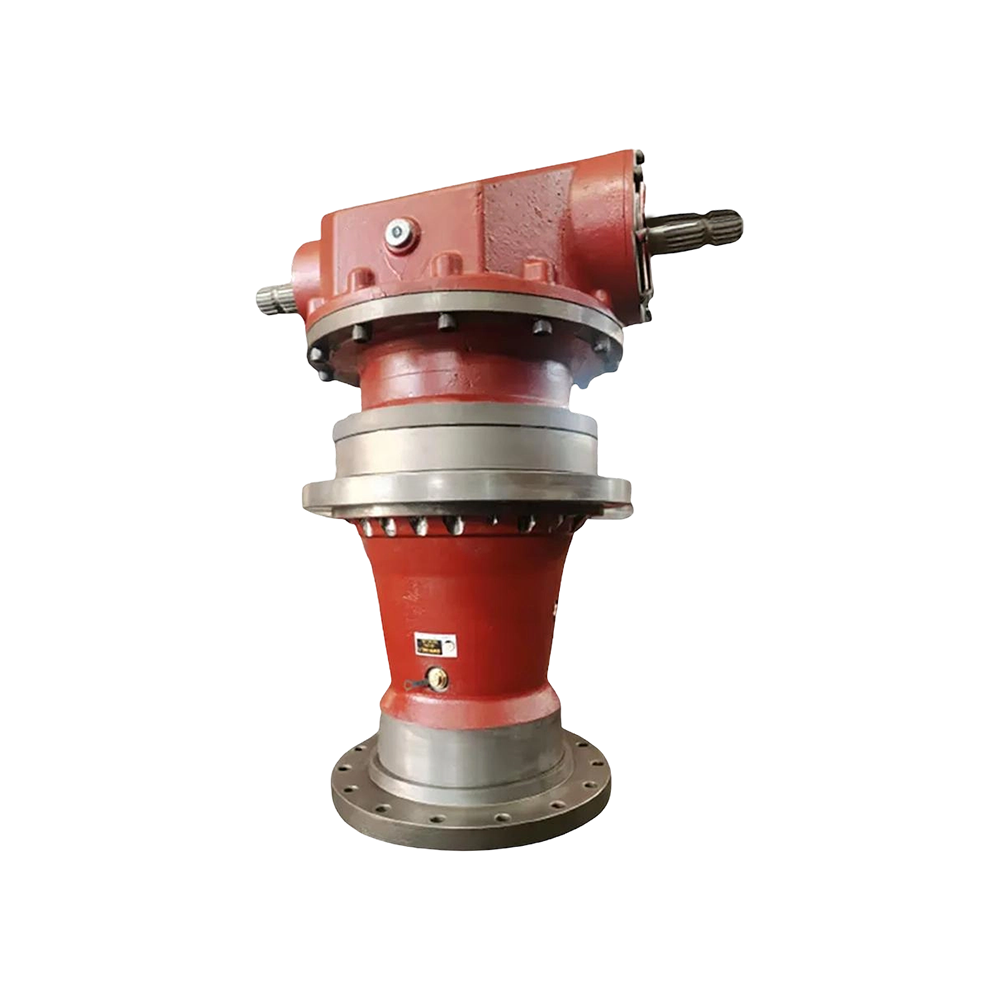 ND PL772 Gearbox for Vertical Twin-Auger TMR MixersA high-torque, synchronized drive for vertical twin-auger TMR mixers, with configuration details matched to each mixer’s auger geometry and ration profile.View Product →
Configuration details such as ratio, output shaft form, flange pattern, input coupling and oil volume are agreed case by case, because two mixers with the same tub volume can still have very different auger geometry and ration profiles.
PL Series Models Commonly Specified for Mixing Duty
The table below shows how the PL models are positioned. Final selection always depends on measured auger torque and the mixer manufacturer's mounting envelope, not on the model name alone.
| Model | Typical duty | Points to confirm before ordering |
|---|---|---|
| ND-PL413 | General mixing and agricultural machinery drive | Ratio, input speed, mounting position |
| ND-PL771 | Feed mixer planetary reduction | Output torque, shaft and flange interface |
| ND-PL772 | Vertical twin-auger TMR mixer | Auger load, axial thrust, oil volume |
Where the machine is a general mixer rather than a TMR design, a lighter planetary reducer from the same family is often enough:
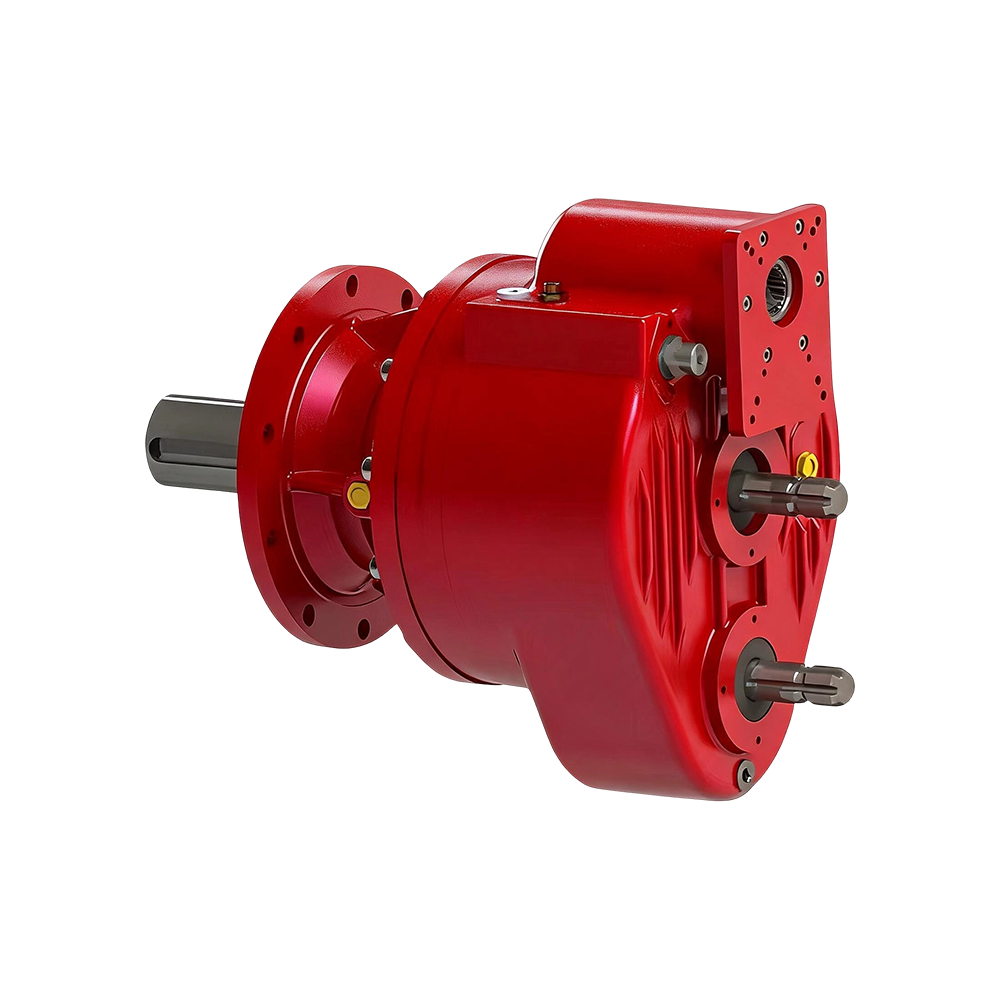 ND PL413 Planetary Gear Reducer for Mixing and Agricultural MachineryProduct Overview The ND PL413 is a versatile planetary gear reducer designed for universal mixing equipment and various agricultural machinery. Featuring standard plan...View Product →
Matching a PL Series Unit to Mixer Size and Ration
Gearbox selection is never a single number. The drive has to be sized against the whole machine, and a unit that is generous for one ration can be marginal for another on the same wagon.
- Tub capacity and the number of augers driven
- Auger diameter, pitch and the condition of the flighting
- Ration density and the share of long fibre or whole bales
- Input power available from the PTO or the hydraulic motor
- Required auger speed against the target mixing time
- Ambient temperature and the number of cycles per day
Ratio choice fixes the auger speed for a given input speed. Run the auger too fast and the ration is thrown around the tub instead of being folded through it; run it too slow and cycle times stretch until the driver shortens the mix. On larger wagons a two-speed arrangement is sometimes used so that one gear breaks bales and loads, while the second gear delivers the final blend at a higher shaft speed. Whether that is worth the extra hardware depends on the ration and on how the feeder wagon is actually used.
A practical rule: size the gearbox on peak torque with a full tub and a stalled auger, then check that the running torque at working speed leaves thermal headroom for a full day of batches.
For feed mixers that are not twin-auger TMR machines, the high-torque planetary reducer below covers the same duty cycle in a different housing envelope:
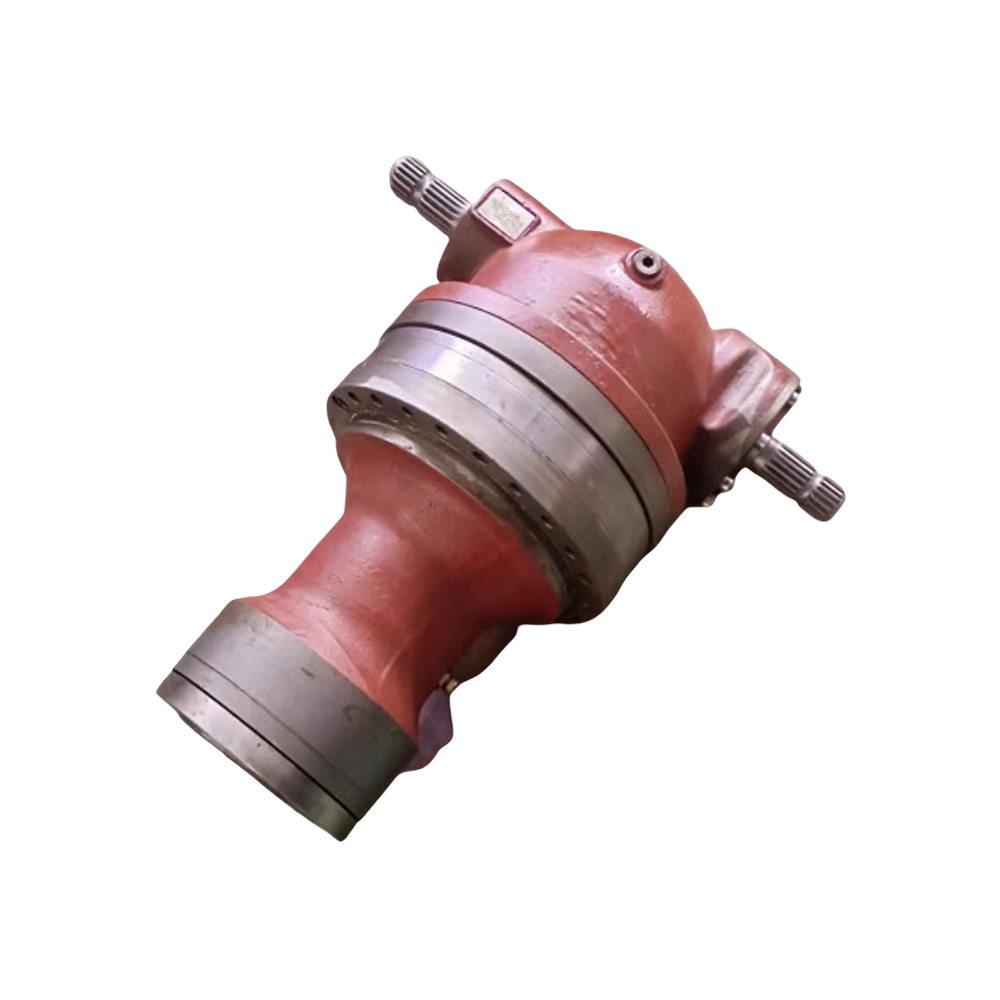 ND PL771 High-Torque Planetary Reducer for Feed MixersAn alternative high-torque planetary reducer for feed mixers outside twin-auger TMR duty, with compact sealed construction for heavy-duty mixing.View Product →
Installation, Lubrication and Service Life
Most premature gearbox failures on feed mixers trace back to installation and oil management rather than to the gears themselves. A short, disciplined routine covers nearly all of it.
- Check that the mounting face on the tub floor is flat, clean and free of weld spatter before the unit is offered up, then torque the bolts in the sequence given on the drawing.
- Align the input coupling or hydraulic motor before tightening the final fasteners, and recheck backlash and end float afterwards.
- Fill with the specified oil grade to the level plug, and schedule the first oil change after the run-in period.
- Keep the breather clean and open; a blocked breather pressurises the housing and pushes oil past the seals.
- Record oil condition at every service. Colour, smell and any metallic sheen tell you more about internal wear than noise alone.
Failure Signals and Replacement Planning
Recognising the difference between a worn seal and a distressed planetary stage saves both money and downtime.
| Sign | Likely cause | Response |
|---|---|---|
| Oil weeping at the output seal | Worn seal, shaft wear or housing pressure | Replace the seal and clean the breather |
| Grey sheen or particles in the oil | Run-in wear or early gear distress | Sample the oil; inspect if particles are flake-like |
| Rising noise and housing heat | Low oil level, wrong grade or bearing wear | Stop the mixer, check level, then inspect |
| Auger stalls under a load it used to mix | Heavier ration, worn flighting or drive fault | Verify the load path before ordering a gearbox |
When a replacement is unavoidable, the critical dimensions are the flange bolt pattern, the output shaft or spline, the ratio, the overall height under the tub and the oil capacity. Holding a spare unit or at least the seal and bearing kit on site is worthwhile on any farm where a stopped mixer means a delayed feed-out.
Frequently Asked Questions
Q1: What does a PL series planetary gearbox do in a TMR mixer?
It reduces the input speed from the PTO or hydraulic motor to the slow, high-torque rotation the vertical auger needs, while supporting the auger's weight and axial thrust inside a compact housing under the tub.
Q2: Can one gearbox design suit both single-auger and twin-auger mixers?
Sometimes, but the torque per auger and the available space under the tub usually differ. Twin-auger TMR machines are normally specified with a unit designed for that vertical layout.
Q3: Is a two-speed drive necessary?
Not on every wagon. It helps where bales and heavy rations are common and where a faster final blend shortens the cycle, but a single-speed planetary unit with the right ratio handles many herds perfectly well.
Q4: How do I identify the correct replacement unit?
Record the nameplate data, then measure the flange bolt circle, shaft spline, ratio and mounting height. Mixer model, tub volume and a photograph of the mounting area make the match far quicker.
Q5: How often should the oil be changed?
Follow the interval in the unit's manual, and shorten it after the first run-in change or whenever the mixer works in dust, high heat or a heavy daily cycle.
Sourcing PL Series Gearboxes for Mixer Builds
Hangzhou Hengnie Machinery has been developing and producing agricultural gearboxes and transmission components since 2010 from its base in the Xiaoshan Industrial Park, Hangzhou. Its ND brand covers cast iron and aluminium housing gearboxes, application-specific families such as the PL series, custom gearboxes, and spare parts including bevel gears, shafts and PTO shafts. The company also develops tooling and automation equipment in-house and provides engineering support for new machine designs.
For a mixer project, the useful starting information is the tub volume, number of augers, auger diameter and pitch, ration profile, available input power and the mounting envelope under the tub. You can read more about the manufacturer and then send the mixer data to the engineering team so a suitable ratio, shaft form and flange pattern can be proposed.
No.6 Wuyashan Road, Langxi Economic Development Zone, Xuancheng City, Anhui, China
+86-563-7370081
