
 English
 中文简体

Industry News
90-Degree Spiral Bevel vs Straight Bevel Aluminum Gearboxes: Efficiency, Noise
Two aluminum gearboxes can share the same 90-degree shaft angle, the same ratio and roughly the same torque rating, yet one whines inside the cab while the other runs quietly for a full season. The difference usually comes down to tooth form: a straight bevel set that meets its mating gear across the whole face at once, or a spiral bevel set that rolls into mesh gradually. This comparison looks at both designs through the two criteria that decide most agricultural transmission projects — efficiency and noise — and explains why the aluminum housing itself changes the final answer.
Content
- 1 What Actually Changes When the Teeth Go From Straight to Spiral
- 2 Efficiency: Where the Losses Really Go
- 3 Noise and Vibration: The Transmission Error Story
- 4 Why the Aluminum Housing Changes the Thermal Calculation
- 5 Matching Tooth Form to the Machine's Duty Cycle
- 6 Specification Checklist Before You Release a Drawing
- 7 FAQ: Spiral Versus Straight Bevel in Aluminum Housings
- 7.0.1 Q1: Is a spiral bevel gearbox always more efficient?
- 7.0.2 Q2: Can I drop a spiral bevel set into a housing designed for straight bevel gears?
- 7.0.3 Q3: How much noise reduction is realistic?
- 7.0.4 Q4: Does an aluminum housing make a gearbox louder?
- 7.0.5 Q5: What information is needed for an accurate quotation?
- 8 Conclusion
What Actually Changes When the Teeth Go From Straight to Spiral
A straight bevel gear carries straight, tapering teeth that converge toward the apex, with the two shafts perpendicular and lying in the same plane. Every tooth enters the mesh along its full face width almost instantly, so the load transfer happens in one sharp step. A spiral bevel gear keeps the same 90-degree shaft angle but curves the teeth along a spiral angle, typically between 25 and 35 degrees, so contact begins at one end of the flank and sweeps across as the gear rotates.
That single geometric change alters almost everything downstream: contact ratio, load sharing, sliding velocity, thrust direction and the vibration signature that eventually reaches the operator's ear.
| Criterion | Straight bevel | 90-degree spiral bevel |
|---|---|---|
| Tooth path | Straight, converging to the apex | Curved along a 25–35° spiral angle |
| Contact ratio | Roughly 1.0–1.2 | Roughly 1.5–2.0 |
| Load sharing | One tooth, sometimes two | Two or more teeth at once |
| Typical mesh efficiency | 98–99% at light, steady load | 97–98.5%, improving under load |
| Noise signature | Sharper entry impact, stronger harmonics | Smoother engagement, lower amplitude |
| Axial thrust | Low | Higher, needs proper bearing support |
| Relative cost | Lower | Higher |
| Best fit | Intermittent, cost-driven duty | Continuous PTO duty, noise-sensitive machines |
Efficiency: Where the Losses Really Go
Gearbox losses come from four places: sliding friction on the tooth flanks, oil churning, bearing drag and seal friction. Straight bevel teeth slide less per mesh because the flanks move almost as pure rolling surfaces, which is why a lightly loaded straight bevel pair can post the higher single-mesh efficiency figure on paper.
Spiral bevel teeth, with their angled flanks, add a wiping component to the motion, so the pure sliding loss at the mesh is slightly higher. That is only half the story. Because several teeth share the load, deflection per tooth drops, the oil film stays intact under torque, and far less energy is converted into vibration and housing noise instead of useful rotation. On a machine running at 540 or 1000 rpm PTO speed for hours, the spiral design often measures equal or better at the system level, especially above 60% of rated torque.
The aluminum housing reinforces that result. Aluminum conducts heat far better than cast iron, so bulk oil temperature settles lower and viscosity stays in the designed band. Lower viscosity means less churning drag and a cooler sump, and a cooler sump protects the film that keeps sliding friction from turning into wear. For context, hypoid gearing adds even more sliding than a spiral bevel set and is noticeably less efficient, which is why it rarely appears in PTO-driven implements.
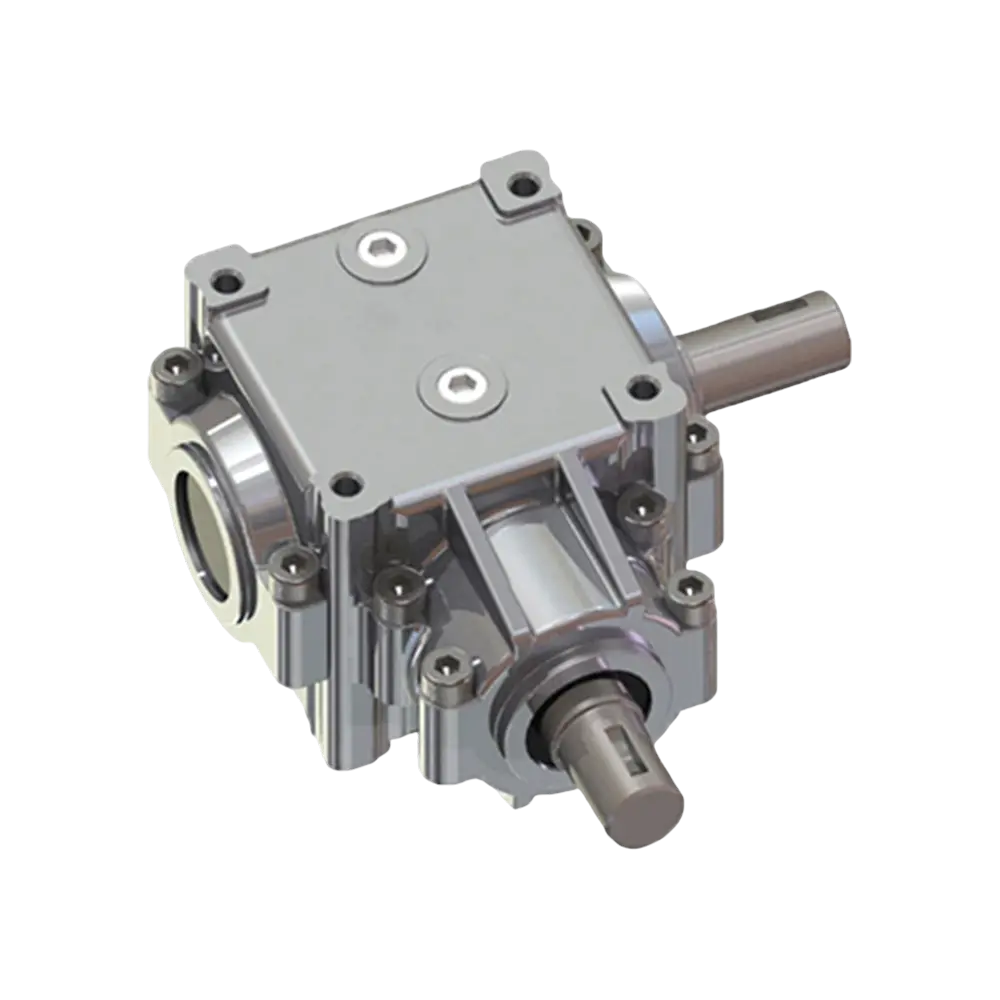 BA73 Aluminum Right-Angle Spiral Bevel Gearbox with Solid ShaftsAluminum-housing right-angle spiral bevel gearbox with solid shafts, suited to compact industrial layouts where heat dissipation and stable transmission are important.View Product →
Noise and Vibration: The Transmission Error Story
Gear noise starts as transmission error — the tiny difference between where the driven gear should be and where it actually is as each tooth takes up load. Transmission error excites the shaft, then the bearings, then the housing panels, and the panels radiate sound.
In a straight bevel set, transmission error spikes at every tooth entry, so the mesh frequency and its harmonics are strong and clean. With 20 teeth at 2000 rpm the mesh tone sits near 670 Hz, squarely in the range the human ear finds most annoying. A spiral bevel set loads its teeth gradually, so the transmission error curve is smoother and its peak amplitude is lower; comparable pairs typically run a few decibels quieter at the same speed and torque, and the tone is less penetrating even when the overall level is similar.
The trade-off is thrust. Curved flanks push the pinion and gear axially, so bearing selection, preload and housing stiffness matter more. A thin-walled aluminum housing with poorly supported bearing bores will give back the acoustic gain in panel radiation. Ribbed walls, generous bosses around the bearing seats and, where needed, steel bore inserts keep the housing from acting as a loudspeaker. Small details count as well: tooth-to-tooth spacing error and backlash scatter often dominate noise at low speed, where the mesh tone is weak but the once-per-revolution knock is not.
Why the Aluminum Housing Changes the Thermal Calculation
Aluminum expands at roughly 23 µm per metre per kelvin, about twice the rate of cast iron. On a 100 mm bearing span with a 60 °C temperature rise, that is a few hundredths of a millimetre of movement — enough to change backlash, preload and the contact pattern if the design ignores it. The practical rule is to specify backlash at operating temperature rather than at the assembly bench, and to use steel or threaded inserts wherever a fastener will be torqued repeatedly.
The upside is dissipation. Aluminum sheds heat quickly, so a compact housing can hold a stable sump temperature without an external cooler, which in turn keeps backlash and lubricant behaviour predictable through a long working day. Grease-for-life units benefit most, since grease life roughly halves for every 10 °C above its rating.
On aluminum bevel boxes, the quietest specification is usually not the tightest bench backlash but the backlash that stays correct once the housing reaches working temperature.
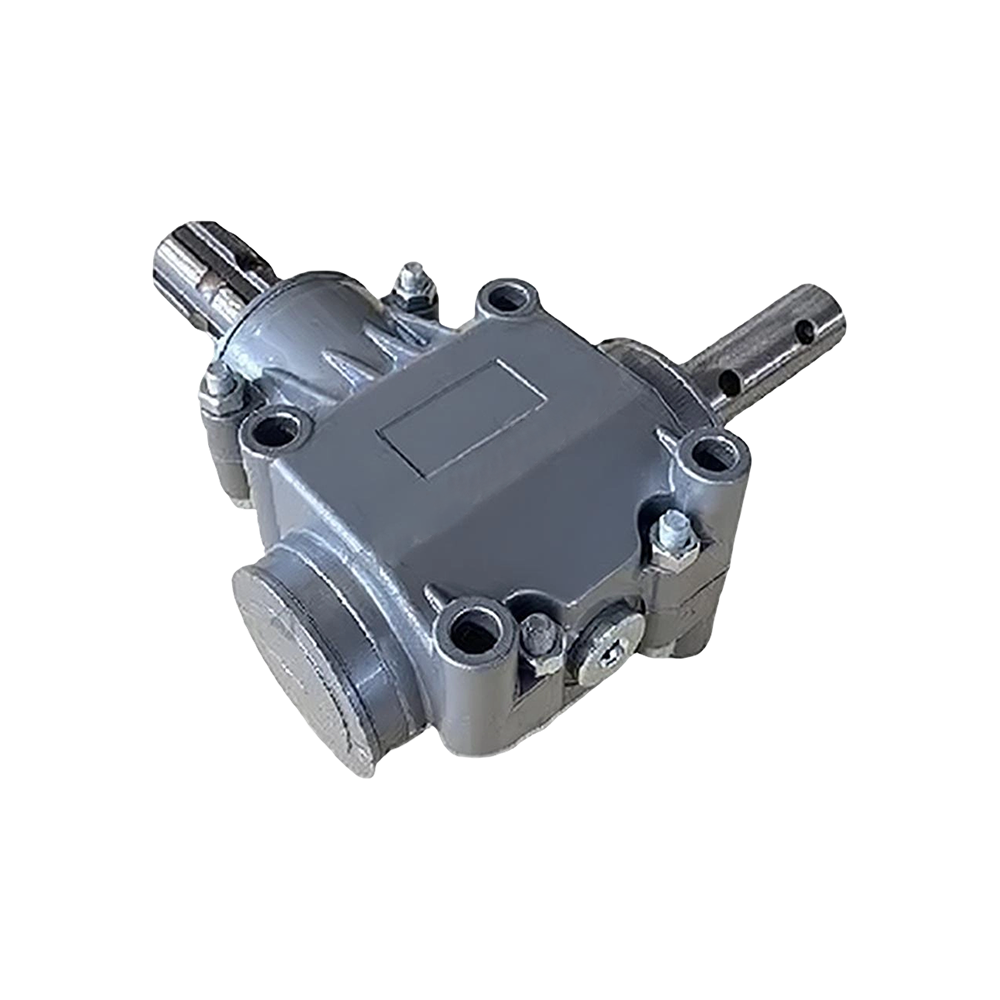 ND BA801 Aluminum 90° Bevel Gearbox for Agricultural TransmissionLightweight 90° agricultural bevel gearbox with a 1:1.9 speed increase and aluminum housing, suited to farm machinery needing compact power-direction changes.View Product →
Matching Tooth Form to the Machine's Duty Cycle
Duty cycle decides more projects than catalogue efficiency does. Machines that run briefly, start under light load and compete hard on unit cost rarely justify spiral tooling. Machines that spin for hours at PTO speed, sit close to an operator or work near livestock usually do.
- Straight bevel is often enough: gate drives, small auger flights, low-speed apron conveyors and light spreader drives where the gearbox sees short bursts.
- Spiral bevel earns its cost: round balers, rotary rakes, corn headers, power harrows and sprayer pumps running continuous shifts where noise and heat accumulate.
- Noise-sensitive sites: barns, orchards near housing and municipal equipment benefit most from the smoother mesh, since the reduction is audible, not just measurable.
- High-torque starts: spiral teeth spread shock load across more than one tooth, which reduces pitting risk on the flank that carries the impact.
Harvest and material-handling duties are a good illustration, because the same tractor PTO drives balers, rakes and conveyors with very different torque profiles; our harvest and material handling solutions page groups those applications by load pattern rather than by gear type alone.
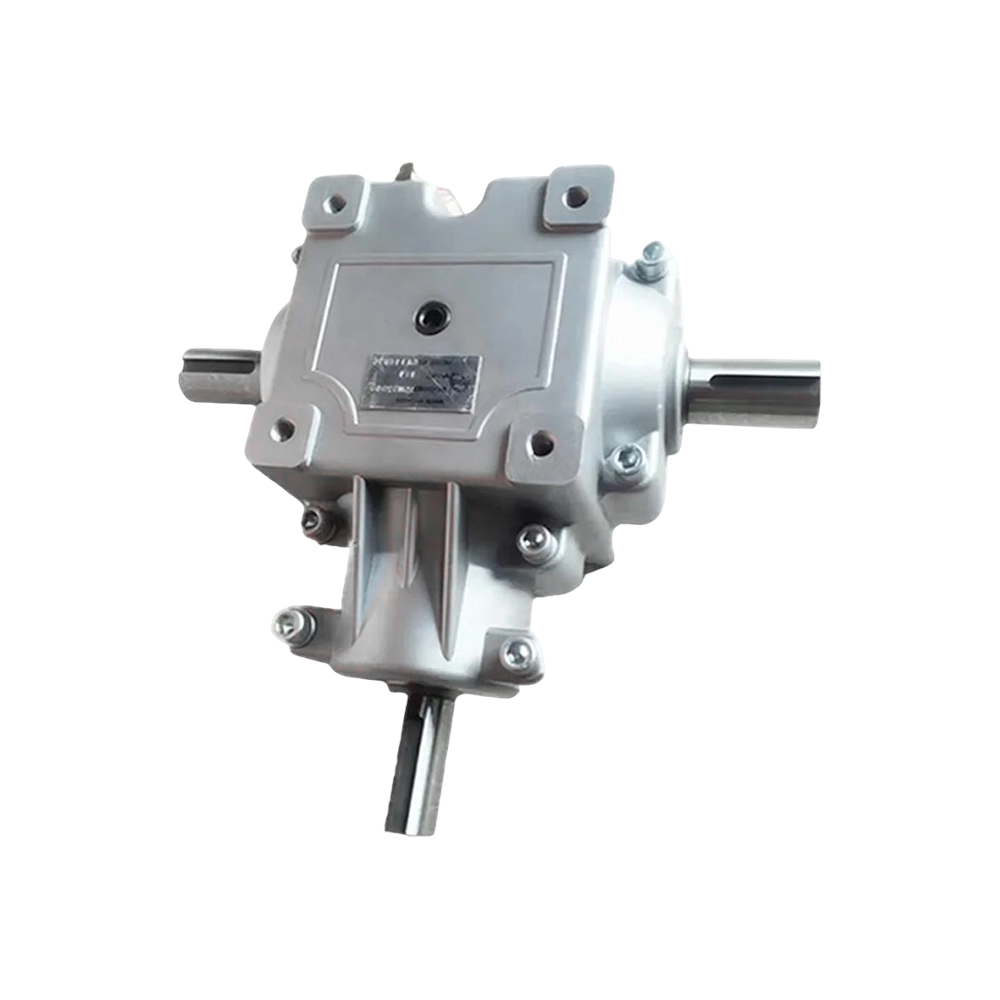 ND BA114 Aluminum Bevel Gearbox for Agricultural Baler MachineryBaler-specific bevel gearbox with aluminum housing, an optimized gear set for periodic impact loads and sealing against straw dust in compact farm machinery.View Product →
Specification Checklist Before You Release a Drawing
- Exact shaft angle and offset, plus the mounting plane the housing registers against.
- Continuous torque, peak torque and the number of starts per hour.
- Input speed range, including any transport or roading condition.
- Backlash target stated at operating temperature, not at 20 °C.
- Lubrication method: oil splash, grease-for-life or forced feed, with the expected service interval.
- Bearing support and bore inserts, particularly on the pinion side where thrust is highest.
- Acceptance noise test: sound pressure at one metre, at a defined speed and load, with the microphone position agreed in advance.
- Mating gear and contact pattern requirement, since bevel sets are matched components.
FAQ: Spiral Versus Straight Bevel in Aluminum Housings
Q1: Is a spiral bevel gearbox always more efficient?
No. At very light load the straight bevel pair can be a fraction more efficient per mesh because it slides less. Once torque and running time rise, the spiral design's better load sharing and lower vibration usually make it the more efficient system.
Q2: Can I drop a spiral bevel set into a housing designed for straight bevel gears?
Rarely without changes. Curved teeth add axial thrust, and mounting distance, bearing selection, backlash and lubrication all have to be reviewed. The housing footprint may survive, but the internals usually will not.
Q3: How much noise reduction is realistic?
A few decibels at comparable speed and torque is typical, and the perceived improvement is often larger because the harsh high-frequency harmonics flatten out. Actual results depend on housing stiffness, mounting and backlash control.
Q4: Does an aluminum housing make a gearbox louder?
Left unribbed and with thin walls, it can radiate more sound than cast iron. Proper ribbing, stiff bearing bosses and, where necessary, steel inserts recover the difference, while the cooler oil keeps backlash stable over long shifts.
Q5: What information is needed for an accurate quotation?
Ratio, shaft angle and offset, continuous and peak torque, duty cycle, mounting orientation, lubrication preference and any noise limit. A worn sample helps, but dimensions and load data decide the design.
Conclusion
Straight bevel gearing remains the economical choice for short-duty, cost-sensitive drives, and in an aluminum housing it delivers a light, compact package. The 90-degree spiral bevel design costs more, adds thrust load and demands better bearing support, but it pays that back through smoother load transfer, cooler running and a noticeably quieter mesh — the three qualities that decide whether a gearbox feels refined or merely adequate in the field. Choosing between them is less about which is better and more about which duty cycle the machine will actually live through. For a wider view of housing materials, ratios and mounting styles across farm transmissions, our agricultural gearbox selection guide covers the families that sit alongside these bevel units.
No.6 Wuyashan Road, Langxi Economic Development Zone, Xuancheng City, Anhui, China
+86-563-7370081
