
 English
 中文简体

Industry News
Direct Drive vs Belt-Driven Motors in Top-Load Washers: Torque and Vibration
A top-load washer's drive system decides how much torque actually reaches the agitator or impeller, and how much of that torque turns into noise, wobble and service calls. Two architectures dominate the category: an induction motor driving through a pulley, belt and gearbox, or a direct drive (DD) motor mounted close to the basket axis. On a parts list the change looks small. In the field it shifts the balance between low-speed torque, vibration isolation, electronic control cost and repairability.
This comparison looks at both layouts from the perspective of washer design and motor sourcing, using the mechanical path of torque and the physical path of vibration as the two lenses. For a wider system-level view of the same question, the site's technical note on direct drive versus belt drive washing machine motors covers control and platform implications in more depth.
Content
- 1 How Each Layout Delivers Torque to the Agitator
- 2 Torque Compared: Starting, Peak and Usable Output
- 3 Where Vibration Actually Comes From
- 4 Noise and Vibration in Real Use
- 5 Off-Balance Spins and Load Sensing
- 6 Cost, Serviceability and Manufacturing Trade-offs
- 7 Choosing the Right Motor for Your Platform
- 8 Frequently Asked Questions
How Each Layout Delivers Torque to the Agitator
Torque at the agitator is not the same as torque at the motor shaft. The drivetrain between them determines how large the motor must be, how fast it turns, and how much of its output survives the trip.
Belt-driven torque path
A permanent split capacitor (PSC) induction motor typically runs at 1,300 to 1,800 rpm. A small motor pulley drives a larger driven pulley, giving a 2:1 to 3:1 speed reduction, and the gearbox behind the clutch adds a further fixed reduction. The result is high agitator torque from a compact, low-cost motor, because torque is multiplied mechanically rather than electromagnetically. The belt also introduces a small amount of controlled slip, which softens shock loads when the agitator meets a heavy, tangled load.
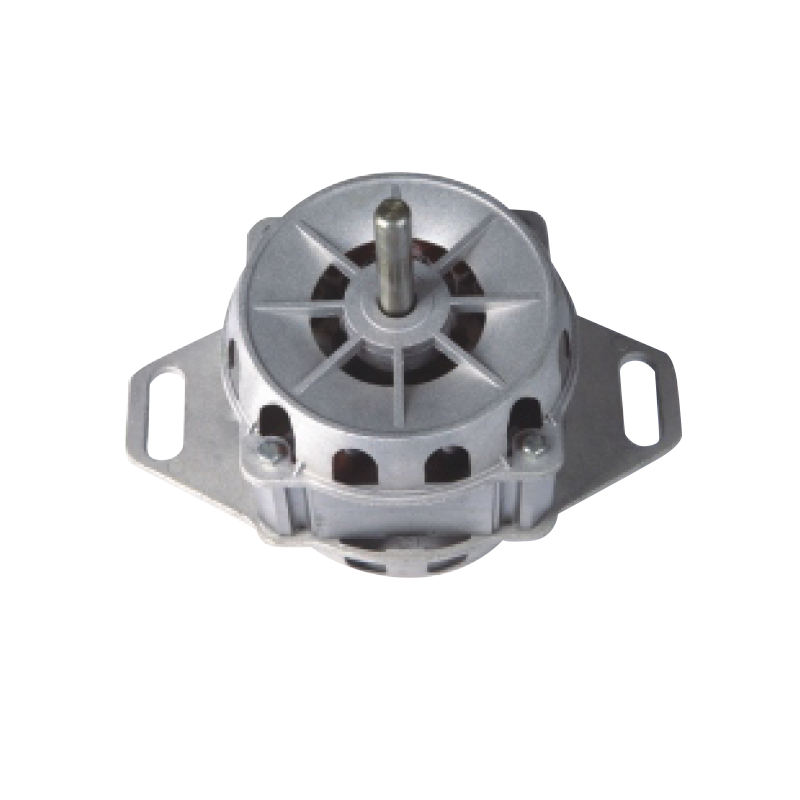
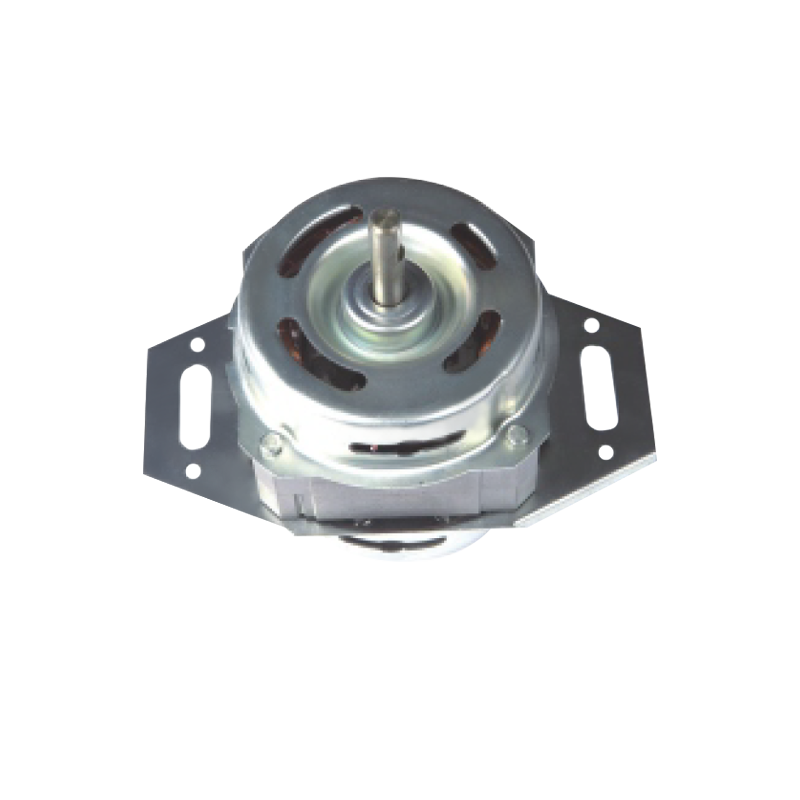 80W Automatic Top-Load Washer Drive Motor JHQ-8803A compact 80W drive motor for fully automatic top-loading washers, built for frequent starts, reversing cycles, and common transmission layouts.View Product →
Direct drive torque path
A direct drive motor is coupled to the basket or agitator shaft with no belt and, in most designs, no gearbox. The motor therefore has to produce working torque at 30 to 200 rpm. That is achieved with a large rotor diameter, a high pole count and a generous magnet volume, controlled by an inverter using field-oriented control. The advantage is precise torque shaping: agitation arcs, soak oscillations and spin ramps can be programmed instead of being fixed by mechanics.
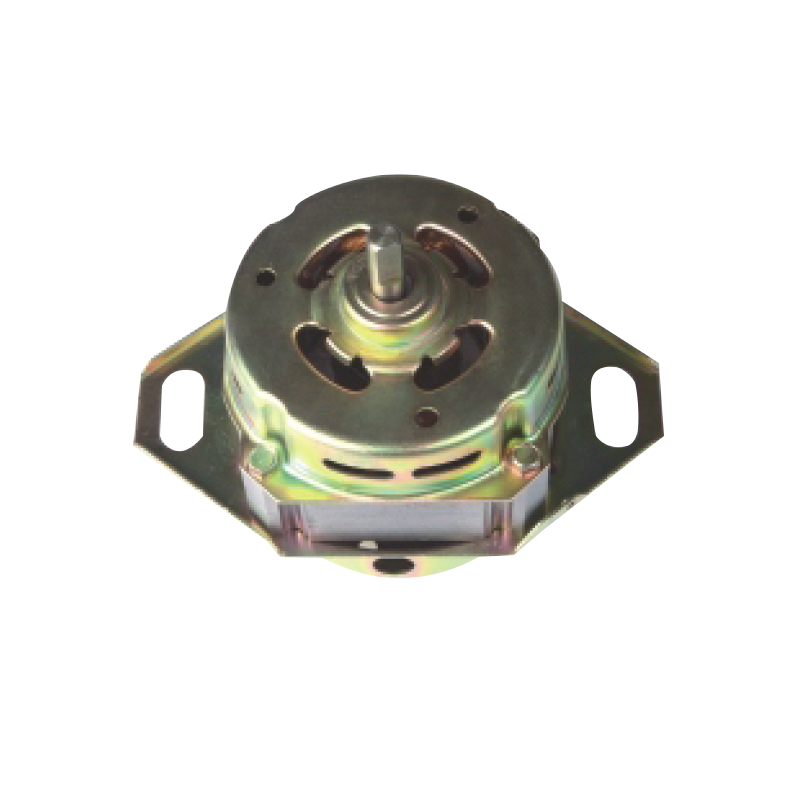 120W Direct Drive Top-Load Washer Motor JHQ-8806A 120W direct-drive motor for automatic top-loading washers, eliminating belts and pulleys to reduce friction, noise, and wear while enabling precise drum control.View Product →
Torque Compared: Starting, Peak and Usable Output
The table below compares the two layouts on the characteristics that matter most during specification and validation. Values are typical ranges, not limits; every platform tunes them differently.
| Characteristic | Belt-driven (induction + pulley/gearbox) | Direct drive (BLDC/PMSM) |
|---|---|---|
| Motor shaft speed | 1,300 to 1,800 rpm | 30 to 900 rpm, load-dependent |
| Torque multiplication | Mechanical, via pulley ratio and gearbox | Electromagnetic, via large diameter and pole count |
| Starting torque | Limited by capacitor and supply; needs a start profile | High and controllable from zero speed |
| Torque control precision | Low; essentially on/off plus triac phase control | High; closed-loop torque and position feedback |
| Efficiency, motor to agitator | Lower, with belt, bearing and gear losses | Higher, with fewer mechanical interfaces |
| Torque ripple | Smoothed by belt compliance and gear inertia | Visible to the structure unless current shaping is used |
The practical conclusion is that belt drive wins on torque per unit of motor cost, while direct drive wins on torque per unit of control freedom. A washer that needs a slow, high-torque wash motion and a fast spin from the same motor benefits far more from DD than a simple two-speed platform does.
Where Vibration Actually Comes From
Vibration in a top-load washer has several independent sources, and the drive layout changes which ones dominate.
- Load imbalance in the basket, the largest low-frequency excitation.
- Rotor eccentricity and residual unbalance in the motor itself.
- Electromagnetic force harmonics set by slot and pole combination.
- Belt frequency, pulley runout and belt tension variation.
- Gear mesh and clutch engagement transients.
The belt as a mechanical filter
A belt is a compliant element in series between motor and tub. It absorbs misalignment, damps high-frequency motor vibration and prevents small rotor errors from reaching the suspension directly. That is why a belt-driven washer with a modest motor can still feel smooth: the drivetrain hides imperfections.
The direct drive penalty
Removing the belt removes that filter. Rotor eccentricity, cogging torque and switching harmonics now couple straight into the basket shaft and the suspension. DD platforms compensate with tighter rotor balancing grades, stiffer shaft bearings, better tub damping and current-based imbalance detection, but the design margin has to be engineered rather than inherited.
Noise and Vibration in Real Use
On the wash floor, the two layouts fail in different ways. Belt-driven machines develop squeal and chirp as belts glaze or tension drops, shed belt dust onto the floor of the cabinet, and grow louder as pulley bearings and gearboxes wear. Motor mounts and clutch springs add their own rattle over time.
Direct drive machines are usually quieter in the low and mid bands and noticeably quieter at start and stop, because there is no belt slap and no gear mesh. What remains is a low-speed growl from the motor and, in some designs, an audible tone at the inverter switching frequency. Because the motor sits on the basket axis, any imbalance in the load is felt closer to the rotor, so spin ramps need to be gentler and imbalance detection more sensitive.
Off-Balance Spins and Load Sensing
Direct drive has a clear advantage in sensing. Motor current and rotor position correlate closely with basket load, so the controller can detect an unbalanced distribution, rock the basket at low speed to redistribute the load, and then ramp to spin. This is what allows higher spin speeds on large-capacity top-loaders without excessive walking or cabinet vibration.
Belt drive can approximate the same function through current sensing and time-based profiles, but belt slip and stretch blur the signal. On the other hand, that same compliance protects the motor from shock loads that a DD stator and bearing set must survive directly. A designer choosing DD should specify bearing preload, shaft hardness and stator rigidity with the same care normally given to the gearbox in a belt platform.
Cost, Serviceability and Manufacturing Trade-offs
Belt drive spreads cost across more parts but keeps each part cheap: a standard induction motor, a stamped pulley, a belt, a tensioner and a gearbox. Service is familiar, and belt or clutch replacement is a routine field repair. Direct drive concentrates value in the motor and the inverter board, reduces part count and assembly time, and removes belt maintenance entirely, but a failure is more expensive because the motor and controller are the critical path.
For DD platforms, manufacturing discipline becomes the quality lever. Rotor balance, lamination stacking, winding symmetry and air-gap consistency all show up directly as vibration, so stator and rotor quality control matters more than it does behind a gearbox. Buyers evaluating suppliers should look at press and winding automation, in-process balancing checks and insulation testing rather than catalogue specifications alone; the company's manufacturing capability overview describes the equipment and quality system behind these process steps.
Choosing the Right Motor for Your Platform
The decision usually follows the product position rather than the technology itself.
- Entry and semi-automatic platforms with mature tooling and a service network favor belt drive for cost and repairability.
- Large-capacity, quiet, high-spin platforms favor direct drive for torque control, imbalance handling and part-count reduction.
- Hybrid designs, such as a direct drive wash motor with a mechanical clutch, sit between the two and suit retrofits of existing cabinets.
- Whatever the layout, verify torque at 40 to 60 rpm, torque ripple over the agitation arc, rotor balance grade, insulation class and moisture protection before signing off on a sample.
For belt-driven and semi-automatic platforms, a high-torque wash motor sized to the gearbox ratio is often the shortest path to better washing performance without changing the drivetrain.
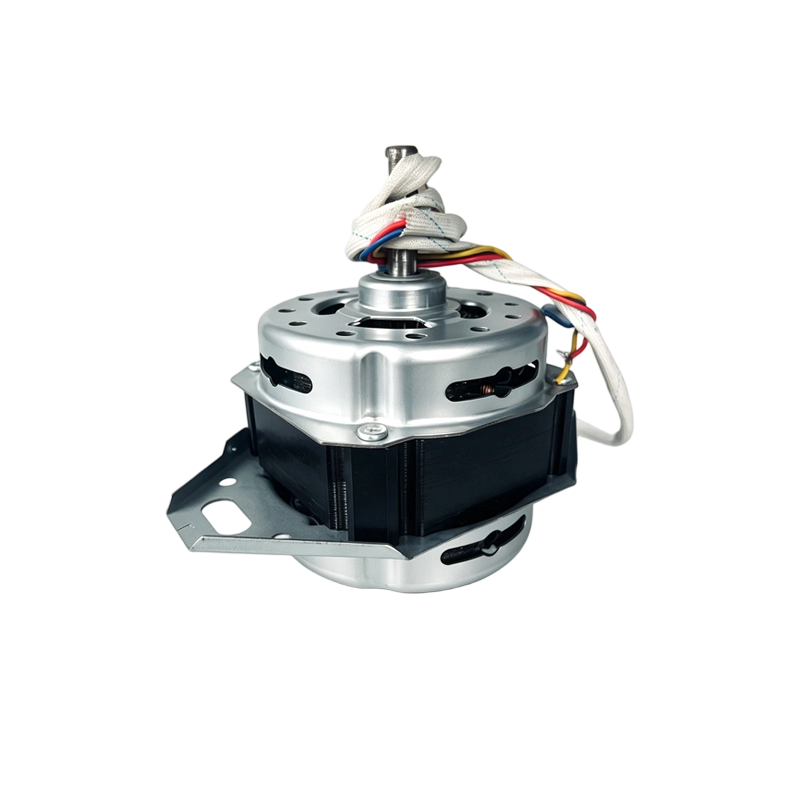 High-Torque Washing Machine Motor JHX-8805A high-torque wash motor for large-capacity washers, delivering strong low-speed agitation and stable rotation across water levels and loads.View Product →
Frequently Asked Questions
Q1: Which layout produces more torque at the agitator?
Belt drive with a gearbox produces the highest torque from the smallest motor, because reduction is mechanical. Direct drive produces comparable torque with a much larger motor diameter and full electronic control over how that torque is delivered.
Q2: Is direct drive always quieter?
Not automatically. It removes belt and gear noise, but rotor eccentricity, cogging torque and inverter tones can reach the cabinet unless rotor balance, suspension tuning and current shaping are handled carefully.
Q3: Which system vibrates less during spin?
Direct drive usually spins smoother at high speed because imbalance can be detected and corrected electronically. Belt drive isolates motor vibration better at low speed thanks to belt compliance.
Q4: Does a belt reduce motor stress?
Yes. Controlled slip absorbs shock loads, so a jammed agitator is less likely to damage the motor. Direct drive designs must compensate through torque limiting in software and more robust bearings.
Q5: Which is cheaper to own over ten years?
Belt drive has lower purchase cost and cheap wear parts, but recurring belt and clutch service adds up. Direct drive has a higher initial cost and fewer maintenance events, with repair cost concentrated in the motor and control board.
Neither layout is universally better. Belt drive remains the pragmatic choice where cost, service infrastructure and mechanical robustness dominate, while direct drive rewards platforms that can invest in motor quality, rotor balance and control electronics. The useful engineering question is not which technology is newer, but which one delivers the required torque curve at an acceptable vibration level for the product's price position, and which supplier can hold that performance across millions of units.
No.6 Wuyashan Road, Langxi Economic Development Zone, Xuancheng City, Anhui, China
+86-563-7370081
